

Board Performance · 2025
In this section15 topics
- Compliance Monitoring — Overview2 items
- Prevention of Conflicts of Interest3 items
- Prevention of the Use of Inside Information3 items
- Anti-Corruption5 items
- Whistleblowing3 items
- Selection of Directors & Chief Executives6 items
- Selection of Independent Directors2 items
- Director Development1 item
- Evaluation of Board & Subcommittee Performance3 items
- Subcommittees1 item
- Meeting Attendance & Remuneration3 items
- Supervision of Subsidiaries & Associated Companies4 items
- Board Duty Performance — Overview1 item
- Audit Committee Duty Performance1 item
- Executive Committee Duty Performance1 item
Compliance Monitoring — Overview
Compliance Monitoring — Introduction
Good corporate governance serves as the foundation for the management and oversight of the company's operations, which contributes to the company's long-term growth and development, leading to sustainable development. Therefore, the company prioritizes adherence to its corporate governance policies. It has established relevant policies and guidelines within its Corporate Governance Policy and Business Ethics Code. The Board of Directors continuously promotes and supports the implementation of good corporate governance principles to serve as a tool for building credibility, transparency, and sustainable long-term growth for the business, maximizing benefits and fostering confidence among shareholders, investors, and all stakeholder groups of the company. Furthermore, it enables the company to adapt to changes in the business environment, leading to long-term growth and creating sustainable value for the enterprise. It also facilitates convenient, swift, equitable, and efficient access for shareholders and the public to monitor the company's operations.
For the period Year 2025 Previously, the company has monitored the implementation of good corporate governance, encompassing content aligned with good corporate governance principles. 4 Categories include: Category Shareholders' Rights and Equitable Treatment of Shareholders Category: Consideration of Stakeholder Roles and Sustainable Business Development Category: Information Disclosure and Transparency, and Category: Responsibilities of Directors
Monitoring of Compliance with Other CG Policies & Guidelines
Employees
The Company ensures compliance with policies and practices on occupational safety, health, and working environment as follows:
1. Training and Development
The Company continuously provides training programs in accordance with legal requirements to ensure that all employees acquire knowledge and understanding of proper work practices. Training is arranged appropriately for employees at all levels regarding their roles and responsibilities in occupational safety, as follows:
The Company’s policies and practices on occupational safety, health, and working environment are included as part of the orientation program for all new employees. Basic safety procedures related to such policies are also communicated to provide initial guidance for employees working at the head office and project sites prior to commencing their duties.
Safety, occupational health, and working environment training programs are provided for employees to ensure that all operational staff understand their roles and responsibilities in workplace safety. Employees are also encouraged to participate with their supervisors in identifying and assessing potential hazards within their work areas. In addition, employees are able to perform their duties in compliance with the Company’s safety, occupational health, and working environment policies, as well as relevant regulations. Further details are available under the section “Employee Information.”
Fire drill training is conducted to prevent employees from harm caused by fire incidents and to minimize potential losses to individuals and business premises. The Company also organizes training for fire wardens and evacuation drills for employees, business partners, and customers in office buildings and high-rise construction projects/condominiums on an annual basis.
2. Workplace Accident Reporting
The Company has established channels for employees to report workplace accidents via the “SCinOne” application, which is easily and quickly accessible. The application records details of workplace accidents and their causes, enabling relevant departments to develop appropriate corrective and preventive measures in accordance with safety standards, thereby ensuring maximum safety for employees as well as external parties working on the Company’s premises.
As a result of the Company’s continuous implementation of occupational safety, health, and working environment initiatives, there were no workplace accident rates, and both work-related injury rates of employees and contractors have decreased, achieving the set targets. This reflects the effectiveness of the Company’s safety management. The statistics on workplace accidents, occupational illness rates, and lost-time injury rates for the year 2025 are as follows:
Statistics | Number of Employees | Days | Person-days |
Statistics for work - related injuries | 0 | - | - |
Statistics for work - related illness | 0 | - | - |
Sick Leave | 1,079 | 4,723 | 4.37 |
Personal Leave | 919 | 2,490 | 2.71 |
Annual Leave | 1,468 | 10,597 | 7.21 |
3. Employee Health Care, Hygiene, Relationships, and Engagement
Further details are available under the section “Sustainable Business Drive”
Business Partners / Contractors
Establish the Code of Conduct for Business Partners and communicate to partners as their guidance for business operations, which enables sustainability in its supply chain. For more details appear at https://www.scasset.com/th/about-us/company-governance/
Formulate supply chain management strategy that considers ESG factors, quality, and delivery timelines. This strategy is designed to drive the Company’s goals across economic, customer, social, and community dimensions, ensuring sustainable business continuity, and developing a long-term competitiveness with partners.
Organize supplier engagement meetings to explain the Company’s policy and plans to contractors for their acknowledgement and in the event that any contractors have any inquiry or problem which require the Company’s actions, or any other questions on any additional guidelines, they can directly contact the Company’s executives.
Provide whistleblowing channels for its business partners to report on any misconducts or unfair treatments, such as through official channels, reporting wrongdoing at https://www.scasset.com/th/about-us/whistleblowing-channels/.
Creditors
In 2025, there were no issues related to financial liquidation and ability to repay debts. According to the review of the Company’s accounting and financial information, it is revealed that no defaulted or late payments to any creditors; both financial institutions and trade creditors, no breach of covenants on misrepresentations or inappropriate disclosure of information, no violation on any terms and conditions of any financial agreements, and no breach of any collateral contracts.
Trade Competitors
In 2025, there were no complaints from the Company’s trade competitors on unfair competition or unfair trade practice against trade competitors.
Communities, Societies and Environment
Further details are available under the section “Sustainable Business Drive”
Non-Infringement of Intellectual Property
The Company has established written policies and practices regarding the non-infringement of intellectual property, copyrights, and computer programs as part of its Good Corporate Governance Policy. These policies require all personnel to perform their duties in compliance with applicable laws and regulations relating to intellectual property rights, including copyrights, patents, trademarks, and other forms of intellectual property.
In 2025, the Board of Directors monitored and reviewed operations related to potential infringement of third-party intellectual property throughout the year. No cases of intellectual property infringement or violations of the Company’s policies and practices on intellectual property, copyrights, or computer programs were identified.
Such practices are consistent with general corporate governance standards, whereby companies require employees to respect and not infringe upon third-party intellectual property and to comply with relevant laws and regulations.
Human Rights Non-Violation
The Company has established a written policy and guidelines to ensure that its business operations are not involved in any human rights violations, in accordance with the UN Guiding Principles on Business and Human Rights (UNGP). This policy is incorporated into the Company’s Good Corporate Governance Policy.
The Company ensures that its operations do not contribute to human rights violations by implementing the following practices:
Supporting and respecting the protection of human rights;
Treating all individuals equally without discrimination based on physical or mental condition, race, nationality, religion, gender, language, age, sexual orientation, disability, education, or social status in employment decisions or employee management;
Prohibiting child labor and not supporting forced labor or illegal migrant labor;
Providing fair and appropriate employment conditions and compensation based on employees’ capabilities;
Establishing appropriate whistleblowing and complaint mechanisms for reporting human rights violations.
In addition, the Company conducts human rights risk assessments to identify potential risks and implement preventive or mitigating measures. This ensures that the Company’s operations remain free from human rights violations. The Company also promotes compliance with human rights principles across its subsidiaries, business partners, and all stakeholders in accordance with international standards.
The Board of Directors has monitored and reviewed the Company’s implementation of human rights practices and found that the Company has fully complied with its established guidelines.
To further promote human rights among stakeholders, the Company has incorporated contractual requirements requiring its business partners to comply with applicable labor laws and regulations, including those related to compensation, occupational health, and workplace safety. For example, contractors must pay wages to their employees at rates not lower than those prescribed by law and must ensure timely payment.
In cases where contractors or counter parties fail to comply, the Company reserves the right, as the employer, to deduct contractual payments and directly pay such wages to the contractors’ employees to protect their rights and prevent unfair treatment.
The Company also strictly prohibits its business partners from employing illegal labor, including child labor or illegal migrant workers. These requirements are established to ensure that all partners conducting business with the Company adhere to human rights principles, including anti-human trafficking practices and zero tolerance for any form of human rights violations.
In 2025, the Company reported no violations of labor laws, employment laws, consumer protection laws, or environmental laws. The Company was not subject to any regulatory actions due to failure to disclose material information within prescribed time frames or for any other reasons.
Innovation Development
Organize internal activity “The SC Evo”, which provides employees with the opportunity to submit innovative project proposal that help improve operations and create value for the organization. This activity aims to foster a culture of innovation within the Company, which align with the Company’s culture #SCSkydive. The activity also encourages employees to learn and adapt to change, enhances creative thinking, and offers all employees the opportunity to play a role in the Company’s development. Please refer to more details in the “SC Sustainable Business Drive”
Information Technology Security
The Company has established policies and guidelines for information technology security policies for the information technology system and the computer network system of the Company and its subsidiaries so that they can efficiently supervise and manage information technology safe and secure. This includes having appropriate measures to prevent and manage information technology risks.
1. Provide various measures to implement information technology security policies Covering the prevention or deterrence of cyber threats, Information Technology Asset Management and readiness of the work system.
2. Provide hardware devices including Redundancy Firewalls to replace legacy devices with a 2.7X increase in Threat prevention Throughput (from 1.0Gb/min to 2.7Gb/min).
3. Provide a highly secure core system by using Citrix VPN to work according to the Hybrid Workplace policy, supporting both the main computer center (Data Center) and the backup computer center (Data Recovery Center).
4. Proper allocation of IT resources, such as Endpoint Protection Platform, using Crowd Strike software that has the ability to detect and deter cyber threats. In addition, the software can detect threats within a minute or explore potential cyber threats within 10 minutes and can fix them within 60 minutes.
Information Disclosure and Transparency
Disclosure of information on shareholdings by Directors and executives, either directly or indirectly, as well as the prescribed policy that Directors and executives must disclose/report their trading activities of the Company shares in every meeting the Board of Directors, and disclose the number of shares that they, their spouses, or minor children hold at the beginning and the end of the year, together with any trading during the year, in the Annual Report.
Submitted the quarterly and yearly financial reports stating unqualified opinions from the auditors to the Securities and Exchange Commission, Thailand/the Stock Exchange of Thailand within the prescribed time frame. The Company has no history of receiving any orders from the regulatory authorities to rectify its financial statements.
Published its Annual Report within 120 days from the end of its fiscal year and publish the invitation letter for the Annual General Meeting of the Shareholders and the Minutes of the latest Annual General Meeting of the Shareholders on the Company’s website.
Appointed 3 auditors from PricewaterhouseCoopers ABAS Ltd.,who were approved by the 2025 Annual General Meeting of the Shareholders namely Miss Sakuna Yamsakul, a certified public accountant, license number 4906 and/or.Mr. Paiboon Tankul, a certified public accountant, license number 4298 and/or Miss Sinsiri Thangsombat,a certified public accountant, license number 7352, who are qualified without any characteristics prohibited by the rules of the Stock Exchange of Thailand, and are approved by the Securities and Exchange Commission, Thailand and the Stock Exchange of Thailand, as well as being independent and without any relationship and/or interests with the Company/its subsidiaries/its executives/its major shareholders or the related parties of such persons. These auditors do not provide any other services to the Company.
Prepared the Report of the Board of Directors’ Responsibilities for the Financial Statements, together with the auditor's report and published them in the Annual Report
Disclosed in the Annual Report and the Company’s website with full disclosure of the Company’s visions and missions, nature of business, financial statements, news releases, shareholder structure, organizational structure, corporate group structure, information on the Board of Directors and executives, investor relations information, Annual Report, Sustainability Report, etc.
Discloses its non-financial performance to better understand customers’ needs and satisfaction with its products and services. This enables the Company to further enhance and improve its products and services to effectively meet customer expectations and satisfaction, as well as to refine its marketing strategies in order to strengthen its competitiveness. Such disclosures include market share and customer satisfaction, as follows:
Market Share
According to a survey by the Agency for Real Estate Affairs (AREA) in 2025, Total presales of single detached houses, townhouses and condominiums in Bangkok Metropolitan Region (BMR) were reported with value of Baht 27,000 million, separated to single detached houses presales by Baht 130,000 million, townhomes presales by Baht 40,000 million and condominiums presales by Baht 100,000 million. In the past year, the Company reported total presales of single detached houses, townhouses and condominiums in BMR accounted for market share at 8% of total presales of single detached houses, townhouses and condominiums in BMR. In addition, The Company’s presales of single detached houses are 13% of total single detached houses’ presales, 1% of total townhouses and home offices’ presales and 5% of total condominiums’presales as well.
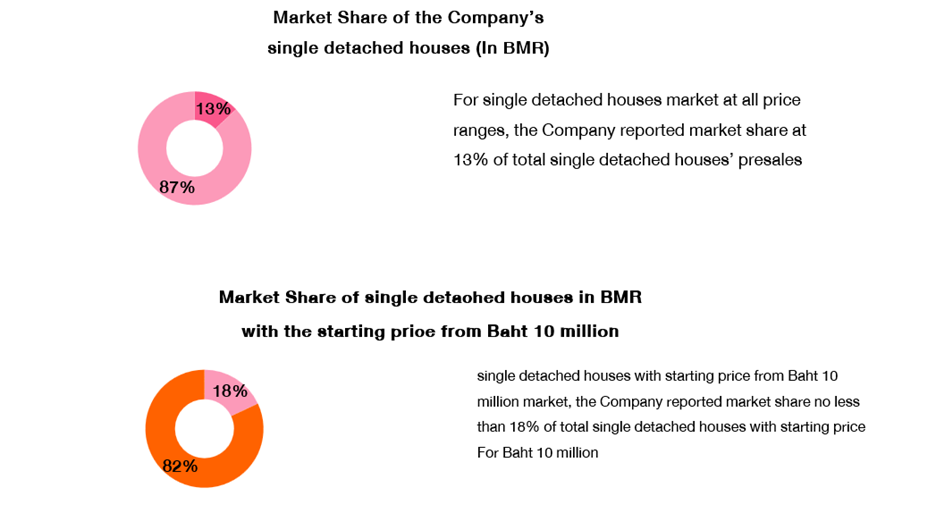
2. Customer Satisfaction (as detailed in the Business-Driven Sustainability section)
Communication Channels
The Company recognizes the importance of information disclosures that are accurate, full, and transparent whether they are financial information, operational results, and other important information. Other than the disclosures that are required by law, the Company also adds many channels for release of information to assure that it is conveniently and equitable accessible to its shareholders, investors or other stakeholders:
Investor Relations Unit: The unit which has direct contact and communication with investors, and security analysts.
Opportunity Day Opportunity Day: The quarterly of the Company’s operational results are releases to investors and analysts which are organized as “Info Meeting” or “Opportunity Day” events.
Press conference and press releases: The Company distributes its press releases and newsletters on its operational results or financial status.
The Company arranges employees’ meetings to clarify its policies, and business directions, as well as explains about its new products. It also disseminates news and information to its employees via electronic channels and media such as intranet, email, and various social medias.
The Company arranges Company Visit Projects for securities analysts.
Annual Report
The Company’s website “www.scasset.com”
In 2025, the Company arranged various activities to provide information in relation to operation results and to communicate with investors via following channels
Activities
Number of times
Info Meetings
4
Press Conferences relating to Business Plan
1
Opportunity Day one-on-one (Company Visit)
3
Site Visit
3
Responsibility of the Board of Directors
The Board of Directors has established the Company’s vision and mission with both short-term 1 year and long-term 5 years in order to steer the executives and employee towards a common goal. In 2025, the Board reviewed the corporate vision and mission for the past fiscal year while recognizing the changes in circumstances and scope of business. It approved the revised corporate vision and mission to assure that they are in line with social environment and current business competition, and still adhere to the core organizational goal of creation of sustainable value.
The Company’s Board of Directors monitors the implementation of the Company’s corporate strategies and follow-up on its implementation assessment by requiring regular reporting of the corporate performances. It also prescribes Key Performance Indicators (KPI) to track different aspects of the company’s performances to ensure that they are in line with the prescribed business plan and strategies. In addition, the Board of Directors monitors the management’s operational performances, and prescribes the reporting of the Company’s operations in the board meetings every quarter, to ensure that the operations, operating results, and operational targets are in line with the prescribed strategies. In 2025, the Board of Directors reviewed the corporate strategies and the annual corporate plan during the half year operations in July 2025 to ensure that they are consistent with the corporate visions and missions, and the key corporate objectives prior set within the strategic framework for the 3 year plan for its business operation. The Board also prescribed the long-term business plan for the Company in 2027 which set forth the revenue growth at Baht 30,000 million, to be the number 1 house brand and increase profit rate from new business opportunities (Engine 2) with average growth rate subject to changes in circumstances and the country’s economic conditions.
To enable the efficient performance of each board member and to ensure that every board member can fully dedicate their time to carry out their duties to Company, the Board of Directors thus prescribed the limitation of positions and directorship in other companies for the Company’s directors and the Chief Executive Officer as follows:
Director may hold director position in other listed companies but not exceed 3 listed companies which SC Asset Corporation Public Company Limited is include. The Directors may also hold position either other non-listed companies or other organizations together with not more than 5 companies as follows;
- The Company’s associated company which operates business other than real estate development, and he/she shall not take the position of the Chief Executive Officer or Managing Directors of such company.
- Charity organization/foundation promoting public benefits and education
In 2025, director holds director position in other listed companies not more than 3 listed companies and other organizations not more than 5 companies.
The Chief Executive Officer shall not maintain any other similar position in any other listed entity except for his/her position in the SC Asset Corporation Public Company Limited; furthermore, he/she shall hold positions no more than 4 the non-listed companies or other organizations:
- The Company’s associated company which operates business other than real estate development, and he/she shall not take the position of the Chief Executive Officer or Managing Directors of such company.
- Charity organization/foundation promoting public benefits and education
In 2025, the Chief Executive Officer (CEO) of the Company hold a position in only 1 listed company, i.e. SC Asset Corporation Public Company Limited only
No director or top executive of the Company should ever have been an employee or a partner of the audit firm that the Company has used for the past two years.
No executive director of the Company holds a directorship position in more than two other listed companies outside the Company’s business group
The Company has established a policy on the minimum quorum requirement, whereby at the time the Board of Directors passes resolutions at a Board meeting, at least two-thirds of the total number of directors must be present. In 2025, the Board convened a total of seven meetings to ensure that it could effectively monitor and oversee the Company’s operations.
The Company has scheduled in advance the meeting dates and agendas for the Board of Directors, subcommittee meetings, and the 2026 Annual General Meeting of Shareholders. All directors were informed of such schedule in advance at the Board of Directors Meeting No. 7/2025 held on 17 December 2025, to enable them to arrange their time and attend meetings collectively. The meeting schedule has also been disclosed on the Company’s website. However, such schedule and agenda may be subject to change as appropriately, and additional meetings may be convened when necessary.
In addition, meetings of non-executive directors (independent directors) were held seven times to consider and provide opinions, objections, or recommendations regarding the Company’s management. These meetings were conducted prior to the Board of Directors meetings. Any opinions, recommendations, or observations raised by the non-executive directors were subsequently reported to the Board of Directors for acknowledgment, enabling the management to consider and take appropriate actions accordingly.
The Company’s Board of directors established a Compliance Unit to support supervision of the work duties of Company’s executives, employees, and business units to ensure their compliance with laws and regulations of the relevant regulatory authorities such as the Securities and Exchange Commission, Thailand and the Stock Exchange of Thailand, and to coordinate with the regulatory authorities to ensure that the operations of the Company are in compliance with the applicable laws, rules, orders, and regulations related to its business. The Board of Directors reviews and sets action plans, governance process, and performance assessment, as well as improves its supervisory plans every year to adapt to the changing business and regulatory environment (Please refer to more details on the Head of Compliance Unit in Attachment 3).
The Board of Directors set up the Internal Audit Office as an internal unit in the Company since the date of the establishment of the Company, and prescribed that the Internal Audit Office shall directly report to the Audit Committee to ensure its independence from the management, as well as allowing the Audit Committee to efficiently monitor the operations of the Company (Please refer to more details on the Head of Compliance Unit in Attachment 3).
In 2025, the Board of Directors committed no fraud and unethical conduct, and no director resigned on matters relating to corporate governance. The Company also has no negative reputation caused by any failure of the board on any oversight of the Company.
Prevention of Conflicts of Interest
Has the Company Acted to Prevent Conflicts of Interest?
Yes
Operations in the Past Year
The Company has established a conflict of interest prevention policy to prevent directors, executives, or employees from using their positions as directors, executives, or employees of the Company to seek personal gain or benefit for others, whether financial or otherwise, which could potentially harm the Company's interests. This policy requires directors and senior executives to report their own conflicts of interest and those of related persons. In cases where a director or executive has a conflict of interest, they must not participate in the decision-making process for that matter, must not attend the meeting, and must abstain from voting on such agenda item, to ensure that the Board of Directors' decisions are fair and for the Company's best interests.
In the year 2568The Company has monitored and investigated cases of conflicts or potential conflicts of interest with the Company as follows:
No directors, executives, or related persons have any conflicts of interest that could arise, therefore no conflict of interest reports have been submitted to the Chairman of the Board and the Chairman of the Audit Committee.
No customer, partner, or stakeholder data has been used without consent or in violation of the personal data protection policy. The Company has appointed a Personal Data Protection Committee, with Mr. Teeratorn Singhaphan, Assistant Managing Director, Legal Department, serving as the Data Controller on behalf of the Company.
No connected transactions or asset acquisitions have been entered into. with directors and/or executives
Number of Conflict-of-Interest Cases
| Metric | Current Year | Previous Year | Two Years Ago |
|---|---|---|---|
| Total number of cases or issues related to conflicts of interest (cases) | 0 | 0 | 0 |
Prevention of the Use of Inside Information
Has the Company Acted to Prevent the Use of Inside Information?
Yes
Operations in the Past Year
The Board of Directors oversees the use of inside information in compliance with laws and good corporate governance principles. This is formally stipulated in the Good Corporate Governance Policy and the Business Ethics Code to prevent the misuse of information for trading the company's securities or seeking other undue benefits. Key policies are summarized as follows:
Directors and executives, including employees in positions or departments responsible for or having access to the company's inside information (including spouses / cohabiting partners and minor children), are prohibited from trading the company's securities within 1 month prior to the disclosure of quarterly and annual financial statements, and within 24 hours after such financial statements are disclosed.
In the year 2025 Previously, the Corporate Secretary's Office would notify relevant individuals via email about the Blackout Period in advance, and it was not found that any directors, executives, or relevant employees traded securities during the period designated by the company for refraining from trading.
It is stipulated that directors and the top 4 executives of the company who wish to trade securities must notify the Board of Directors at least 1 business day in advance and are obliged to report changes in securities holdings to the SEC Office within 3 business days from the date of change via the SEC Office website, as well as report to the Board of Directors at the next meeting.
In the year 2025 Previously, directors and executives traded a total of 4 times, and upon inspection, it was found that the company's policies were correctly and fully complied with.
The report on the acquisition and disposal of the company's securities by the top 4 directors and executives in 2025 is as follows:
Securities holdings of directors, spouses, and minor children
List of Directors | In 2024 | In 2025 | |||
Number of shares As of December 31 | Number of shares Acquired during the year | Number of shares disposed during the year | Number of shares As of December 31 December 2025 | ||
1. Mr. Rath | Kitivejosoth | 0 | 0 | 0 | 0 |
2. Mr. Nuttaphong Spouse (1) | Kunakornwong | 4,673,495 1,176,915,495 | 0 0 | 0 0 | 4,673,495 1,176,915,495 |
3. Mr. Nathpath | Ouajai | 0 | 0 | 0 | 0 |
4. Mr. Nitath | Nhawapathadoln | 0 | 0 | 0 | 0 |
5. Mr. Precha | Sekhararidhi | 37,968 | 0 | 0 | 37,968 |
6. Mr. Songsak | Premsuk | 0 | 0 | 0 | 0 |
7. Ms. Vilasinee | Puddhikarant | 0 | 0 | 0 | 0 |
8. Mr. Attapol | Sariddipuntawat | 12,889,843 | 0 | 0 | 12,889,843 |
9. Mr. Anek | Panaapichon | 0 | 0 | 0 | 0 |
10. Dr. Tanai | Charinsarn | 0 | 0 | 0 | 0 |
11. Mr. Somboon | Kuptimanus | 9,561,612 | 0 | 0 | 9,561,612 |
Note:
Mr. Nattaphong Kunakornwong's spouse, Ms. Pintongta Shinawatra Kunakornwong, holds 1,176,915,495 shares, which were held before Mr. Nattaphong Kunakornwong was elected as a director on March 1, 2012.
Excluding directors and/or executives who resigned or vacated their positions during the year.
Securities holdings of the top 4 executives, spouses, and minor children
List of Executives | In 2024 | In 2025 | |||
Number of shares As of December 31 | Number of shares Acquired during the year | Number of shares disposed during the year | Number of shares As of December 31 December 2025 | ||
1. Ms. Namtip | Promchua | 2,500,000 | 0 | 0 | 2,500,000 |
2. Mr. Putikarn | Aurat | 0 | 0 | 0 | 0 |
3. Mr. Manit | Banchongthanakit | 1,748,503 | 0 | 0 | 1,748,503 |
4. Mr. Mongkut | Techolarn | 2,500,000 | 0 | 0 | 2,500,000 |
5. Ms. Kanokon | Limkumnerd | 0 | 0 | 0 | 0 |
Number of Inside-Information Cases
| Metric | Current Year | Previous Year | Two Years Ago |
|---|---|---|---|
| Total number of cases or issues related to the use of inside information to seek benefits (cases) | 0 | 0 | 0 |
Anti-Corruption
Has the Company Acted on Anti-Corruption?
Yes
Operations in the Past Year
The Company has established an anti-corruption policy and measures, which stipulate that the Company's operations must not be involved in any form of fraud and corruption, whether it be giving, soliciting, or accepting bribes or benefits in various forms. This anti-corruption policy and measures have been approved by the Board of Directors and are reviewed annually for their suitability to align with the Company's business operational risks, ensuring that the Company's anti-corruption policy and measures remain appropriate and consistent with the Company's business context. Furthermore, it encourages directors, executives, and employees to consistently comply with the anti-corruption policy and measures to prevent all forms of corruption.
In the past year 2025, the Company has taken the following actions to comply with its anti-corruption policy and measures:
Review the Company's anti-corruption policy and measures to ensure that the Company has appropriate and adequate policies and measures, along with clear operational guidelines, to prevent risks that could lead to corruption.
The Risk Management Committee assessed business risks to identify the Company's operational processes that might be susceptible to corruption. It also assigned responsibilities to each department and established guidelines for risk mitigation, prevention, and control of corruption. Directors, executives, and employees at all levels are prohibited from engaging in or being involved in corruption, directly or indirectly. Directors, executives, employees, and the Company's business partners must adhere to the measures set by the Company, which seriously cover various operational processes. For example, directors, executives, and employees are prohibited from using their positions as directors, executives, or employees of the Company to seek personal gain or benefits for others. Executives and employees at all levels are prohibited from accepting or giving gifts, souvenirs, or any other benefits on behalf of the Company during all festivals (No Gift Policy). Furthermore, as the Company's core business involves real estate development, requiring land allocation permits and building construction permits, the Company strictly prohibits all forms of bribery to government officials, as well as requesting or providing any favors from external organizations, especially government agencies, which must comply with the Company's regulations or government agency practices applicable to the general public, without supporting any form of reciprocal bribery.
Communicate the anti-corruption policy and measures, as well as any relevant laws or regulations, to directors, executives, and employees to foster understanding and instill a conscience to refrain from corruption and recognize the dangers of such actions. Furthermore, to ensure all employees are aware of various forms of corruption, its impacts, damages resulting from corruption, methods to avoid and control corruption, penalties for violating the Company's anti-corruption policy and measures, and procedures for complaints, reporting, and whistleblowing when corruption is observed or suspected. This also aims to cultivate a sense of participation among employees as part of the Company's organizational culture and to make them aware of the dangers of corruption affecting themselves, their families, and society.
In the year In 2025, the Company developed a course on anti-corruption policy and measures through the "SCinOne" Application system. All employees are required to undergo training and test their knowledge and understanding of anti-corruption in accordance with the Company's anti-corruption policy and measures. This topic is also part of the orientation for all new employees, who must complete the training before starting work. Currently, 100% of the Company's employees have completed the training. Furthermore, communication has been sent via email to all employees regarding potential corruption risks and operational guidelines to prevent corruption, such as the announcement of the No Gift Policy, which the Company has continuously implemented for the 8th consecutive year. during important festivals, and the whistleblowing channel (SC Whistleblowing System) via the "SCinOne" Application system, among others.
The Company continuously monitors and evaluates compliance with its anti-corruption policy and measures. The Internal Audit Department is assigned to oversee and track compliance with the Company's anti-corruption policy and measures, and to report the results of compliance to the Audit Committee for further reporting to the Board of Directors. Throughout the past year, there has been no non-compliance with the policy by directors, executives, or employees.
The Audit Committee is responsible for reviewing the completeness and adequacy of all operational processes within the Company to ensure correctness. This includes overseeing the internal control system to be efficient and effective, ensuring adequate and appropriate risk management, and arranging for the regular evaluation, review, and revision of the Company's anti-corruption policy and measures at least once a year. This is to consider changing risks and establish operational guidelines consistent with policies, procedures, requirements, regulations, announcements, laws, and business changes, as well as to find measures to mitigate those risks.
In the year 2025 The Internal Audit Office reported the results of its audit in accordance with anti-corruption measures. The scope of consideration covered compliance with the anti-corruption policy and measures, and the effectiveness of the internal control system in adequately controlling corruption. The adequacy of the Company's internal control system was considered and reviewed based on the Securities and Exchange Commission (SEC)'s internal control system adequacy assessment form. The issues considered included the assessment of various operational risks of the Company, including risks related to corruption. The assessment results indicated that the Company has an adequate, appropriate, and comprehensive internal control system in all aspects, and this was reported to the Board of Directors for acknowledgment.
The Company has received renewal of its membership certification from the Private Sector Collective Action Coalition Against Corruption (CAC), continuously demonstrating its stance as a transparent organization for the past 8 years (2nd renewal). This serves as confirmation that the Company promotes and prioritizes anti-corruption efforts and maintains its position as a transparent organization.
In the year 2025 In the past, the Company has campaigned against corruption both internally and externally, and continuously monitored and evaluated policy compliance. The Company detected actions violating the anti-corruption policy and measures within the organization. 2 In this case, the Company has already disciplined the employee in accordance with company regulations and the law. The Company found no actions violating the anti-corruption policy and measures between business partners and external parties.
Following the discovery of the incident, the Company took the following actions:
(1) The Company established a fact-finding committee to gather information and ensure fairness to all parties. The Company has taken legal action against the employee who committed the offense.
(2) To prevent recurrence of misconduct, the Company has continuously communicated to raise awareness and understanding among executives and employees within the organization regarding what actions violate the Company's anti-corruption policy and measures. Additionally, operational procedures have been improved to prevent such misconduct from occurring again.
Form of Anti-Corruption Operations
| Operation |
|---|
| Review of appropriateness in anti-corruption |
| The participation in anti-corruption projects |
| Assessment and identification of corruption risk |
| Communication and training for employees on anti-corruption policy and guidelines |
| The monitoring of the evaluation of compliance with the anti- corruption policy |
| Review of the completeness and adequacy of the process by the Audit Committee or auditor |
Number of Corruption Cases
| Metric | Current Year | Previous Year | Two Years Ago |
|---|---|---|---|
| Total number of cases or issues related to corruption (cases) | 2 | 1 | 1 |
Details of Corruption Cases
| Status | Period Type | Start of Period | End of Period | Details of the Case or Issue | Investigation Results | Corrective Actions |
|---|---|---|---|---|---|---|
| Incident no longer subject to action | month/year Range | 2025-01 | 2025-12 | Employee solicits money from contractor | To terminate employment | 1. Revise the procurement process by converting all projects to auctions, conducted through a central agency and with notification to all vendors (not limited to a select group). 2. Announce a policy prohibiting employees and companies involved in misconduct or corruption from undertaking company work. |
| Incident no longer subject to action | month/year Range | 2025-01 | 2025-12 | Employees undertaking repair and renovation work that competes with the company's business. | Termination of employment | Policy prohibiting employees as follows: 1. Employees are prohibited from using their authority or participating in business competition that conflicts with the company's interests. 2. Employees are prohibited from partnering with contractors, which would compromise impartiality and benefit themselves and their close associates. 3. Employees are prohibited from acting as brokers for external companies providing services to residents in the project. The investigation committee, in conjunction with management, will organize a clarification meeting for all employees under their supervision regarding the scope of permissible and impermissible services. |
Whistleblowing
Has the Company Implemented Whistleblowing Procedures?
Yes
Operations in the Past Year
The Company has established channels for all stakeholder groups to report information and submit complaints through designated channels, including postal mail or electronic mail (E-mail) to each director, the Company Secretary, and the Internal Audit Department, as well as reporting via the Call Center (1749) and the internal application developed by the Company. An independent fact-finding committee, separate from management, will consider these reports, and the Internal Audit Department will be responsible for screening such information and complaints.
Number of Whistleblowing Cases
| Metric | Current Year | Previous Year | Two Years Ago |
|---|---|---|---|
| Total number of cases or issues received through whistleblowing channels (cases) | 0 | 0 | 0 |
Selection of Directors & Chief Executives
Selection — Introduction
For the appointment of directors and independent directors of the Company, the Nomination and Remuneration Committee, which comprises the entire independent director committee, is responsible for the nomination process. This is conducted through a careful and prudent screening and consideration process. The nominated directors must possess qualifications as stipulated by the Company, and if they are independent directors, they must meet the qualifications of independent directors as defined by the Company. Additionally, consideration is given to the suitability of qualifications, experience, skills, and professional expertise, including the composition of the total number of directors of the Company, the diversity in the board structure, as well as essential skills currently lacking in the board, based on the Board Skill Matrix. This is to ensure the selection of individuals with abilities and experience relevant to the Company's business, who can fully dedicate their time to their duties, and whose selection is appropriate and consistent with the Company's short-term and long-term business strategies. Directors will be proposed in a number equal to those whose terms have expired, for approval by the Board of Directors. Subsequently, the list of these directors will be presented to the shareholders' meeting for further consideration and approval.
Furthermore, the Company provides shareholders with the opportunity to nominate individuals for selection as directors at least 3 months prior to the end of the accounting year, by notifying through the news system of the Stock Exchange of Thailand and the Company's website. However, in 2025, no shareholder nominated any individual for election as a company director.
When considering the reappointment of existing directors for another term, the Nomination and Remuneration Committee will consider various factors, including performance, attendance records, participation in meetings, and support for the activities of the Board of Directors. If the director is an independent director, their independence will also be considered.
Newly appointed directors will receive an orientation to be informed of general information, an overview of key business operations, and a summary of the performance of each business line. They will also be informed of compliance with relevant laws and regulations, such as the roles and responsibilities of directors in a listed company, the Company's securities trading policy, and other related policies. Senior executives will present this information and prepare relevant company data for the new directors. In the year In 2025, the Company did not recruit new directors.
Directors & Chief Executives — Introduction
The Nomination and Remuneration Committee conducts the selection of qualified individuals to serve as directors and independent directors, considering diversity, skills, and experience that align with the company's current and future business operations. This includes considering names suggested by shareholders, directors, and the director database of the Thai Institute of Directors (IOD), and proposing them to the Board of Directors for appointment or seeking approval for appointment from shareholders in accordance with the company's articles of association.
The Nomination and Remuneration Committee, in conjunction with the Chief Executive Officer, develops the Chief Executive Officer's Succession Plan. This involves identifying suitable candidates from both within and outside the organization, based on the principle of considering qualified individuals from internal and external sources. The committee may also consider engaging independent consultants to assist in this selection process.
In the selection of the Chief Executive Officer, suitable individuals will be considered based on their skills, knowledge, abilities, leadership, and experience that are essential and beneficial to business operations. This includes experience in real estate development or in professional fields beneficial to organizational management, or a proven track record in organizational management with a recognized reputation in both public and private institutional organizations, both domestically and internationally. The candidate must also possess an outstanding vision capable of leading the organization to success and achieving the company's sustainable development goals. The Nomination and Remuneration Committee will propose the selected individual to the Board of Directors for further consideration and appointment.
Furthermore, the company has also established a Succession Plan for the next two levels of management, which are considered critical positions for organizational administration. This plan identifies individuals to act as replacements. In cases where no immediate replacement is available, the company has implemented a personnel development system for subordinate levels. (Leadership Development Program : LDP ) to prepare and also recruit from external sources. This is to maintain confidence among corporate investors and employees that the company's operations will be continued promptly. The company has developed individual personnel development plans ( Individual Development Plan : IDP ) for successors at all positions and levels, to develop them to be ready to assume the role.
Are Directors Selected Through the Nomination Committee?
Yes
Are Chief Executives Selected Through the Nomination Committee?
Yes
Rights of Minority Shareholders on Director Appointment
Criteria and procedures for the election of directors at the shareholders' meeting.
(1) Each shareholder shall have votes equal to the number of shares held, i.e., one share equals one vote. (2) Each shareholder may use all votes available under (1) to elect one or more persons as directors. In the case of electing multiple persons as directors, votes cannot be divided unequally among them. For voting, shareholders shall use a ballot to appoint directors individually, according to the list of persons nominated as directors on the ballot.
(3) The persons who receive the highest votes in descending order shall be elected as directors, equal to the number of directors to be appointed or elected at that time. In the event that persons elected in the subsequent order receive an equal number of votes exceeding the number of directors to be appointed or elected at that time, the Chairman shall cast the deciding vote.
(4) The Company separates the matters of director election and director remuneration into separate agendas. For the director election agenda, shareholders are given the opportunity to cast individual votes for directors, with director nominees presented for individual shareholder voting. For the director remuneration agenda, clear criteria and procedures for proposing director remuneration are presented, explaining the components and total remuneration offered, as well as clarifying the policies, methods, and criteria for providing remuneration to directors and sub-committee members in each position for shareholders' acknowledgment.
Method of Director Appointment
| Method |
|---|
| Method whereby each director requires approval votes more than half of the votes of attending shareholders with voting rights |
Selection of Independent Directors
Criteria for Selecting Independent Directors
1. The Nomination and Remuneration Committee is responsible for nominating, selecting suitable individuals, and proposing them to the Board of Directors for consideration of appointment or for seeking approval of appointment from the shareholders' meeting in accordance with the Company's Articles of Association.
2. The Nomination and Remuneration Committee considers the suitability of the composition, including the qualifications of both current and future directors, diversity in terms of gender, age, and experience, legal misconduct history, independence, business direction, and the overall composition of the Board of Directors, to compare with the current and future business direction. A Board Skill Matrix is prepared to define the criteria for desired director nominations annually. In this review, the Nomination and Remuneration Committee also considers diversity from various nomination sources, such as recommendations from the Board of Directors, nominations by shareholders, external consulting firms, and the director database of the Thai Institute of Directors Association, among others.
3. In considering the re-appointment of existing directors for another term, the Nomination and Remuneration Committee will consider various factors, including performance, attendance and participation in meetings, and support for the activities of the Board of Directors. In the case of independent directors, their independence will also be considered.
4. The appointment of directors shall be in accordance with the Company's Articles of Association and relevant legal requirements, which must be transparent and clear, and shall be carried out through the Nomination and Remuneration Committee. The criteria and methods for electing directors at the shareholders' meeting can be studied from the rights of minority investors in appointing directors, which the Company has disclosed on its website.
5. In the event that a director's position becomes vacant for reasons other than the expiration of their term, the Board of Directors shall consider appointing a qualified person who does not possess any prohibited characteristics under the law to serve as a replacement director at a Board meeting, unless the remaining term of the vacating director is less than 2 months. The replacement director shall serve only for the remainder of the term of the director they replace. The resolution for such an appointment must receive votes from no less than three-fourths of the remaining directors.
6. The Company sets qualifications for independent directors that are more stringent than the minimum criteria prescribed by law, such as holding no more than 0.5% of the total voting shares of the Company, its major shareholders, subsidiaries, associated companies, or any juristic person that may have a conflict of interest, including shares held by related parties. The requirements regarding the qualifications of independent directors can be studied from the Corporate Governance Policy.
7. Currently, the Company has 7 independent directors, namely Mr. Rat Kittivechosoth, Mr. Preecha Sekharariddhi, Mr. Nitat Navaphatthadon, Mrs. Songsak Premsuk, Mrs. Vilasinee Puthikarant, Mr. Anek Panapichon, and Dr. Thanai Charinsarn. The Company sets the proportion of independent directors to be more than 50% of the total directors to ensure that shareholders and all stakeholders can be confident that the Board of Directors can perform its duties as representatives of the shareholders independently and with an appropriate system of checks and balances. As of December 31, 2025 The Company has 7 independent directors, representing 63.64%.
Did Any Independent Director Have a Business or Professional Relationship?
No
Director Development
Development of Directors in the Past Year
The Company desires its directors to develop their knowledge, capabilities, and skills in performing their duties as directors, encompassing the nature of the Company's business, good corporate governance principles, and other courses beneficial to their performance. The Company encourages directors to consider attending training with the Thai Institute of Directors (IOD) in courses of their interest. Furthermore, the Company also supports organizing internal training (SC Learning Hub) by regularly inviting experts and consultants to present information beneficial for the continuous development of knowledge for directors' performance of duties.
Evaluation of Board & Subcommittee Performance
Criteria for Evaluating Board Performance
In 2025, the company conducted a performance evaluation of the Board of Directors, both individually and as a whole. The evaluation content covered the structure and qualifications of the directors, their roles, duties, and responsibilities, meeting attendance, performance of duties, self-development, and their relationship with management. The objective was to review performance, issues, and various obstacles.
Evaluation of Board Performance in the Past Year
For the performance evaluation criteria of the company's board of directors and sub-committees, both individual and collective, the evaluation criteria are divided into 5 levels, from 1-5, with 5 being the best evaluation result. The evaluation results for all sets of the company's board of directors and sub-committees indicate that all sets of the board of directors and sub-committees have fully performed their duties within their scope of authority and in accordance with good corporate governance principles, achieving scores exceeding the set targets.
Summary of the performance evaluation of the board of directors
The performance evaluation of the board of directors on a committee basis (evaluation of the entire committee) is equal to 99.61 percent
The performance evaluation of the board of directors on an individual basis (self-assessment) is equal to 99.13 percent.
The performance evaluation of the board of directors on an individual basis (assessment by others) is equal to 99.37 percent.
Evaluation Results
| Evaluated Body | Group — Carried Out? | Group — Grade / Average Score | Group — Grade / Full Score | Individual (Self-Assessment) — Carried Out? | Individual (Self-Assessment) — Grade / Average Score | Individual (Self-Assessment) — Grade / Full Score | Cross (Assessing Other Directors) — Carried Out? | Cross (Assessing Other Directors) — Grade / Average Score | Cross (Assessing Other Directors) — Grade / Full Score |
|---|---|---|---|---|---|---|---|---|---|
| Board Of Director | Y | 99.61 | 100 | Y | 99.13 | 100 | Y | 99.37 | 100 |
Subcommittees
Subcommittees
| Results of the Subcommittee's Duty Performance |
|---|
The Board of Directors of SC Asset Corporation Public Company Limited has appointed a Nomination and Remuneration Committee, comprising a total of 3 directors and independent directors of the company, as follows:
The establishment of the Nomination and Remuneration Committee is part of the company's good corporate governance. The Nomination and Remuneration Committee has duties and responsibilities according to its charter, primarily as follows:
In the year 2025, the Nomination and Remuneration Committee held a total of 2 meetings to jointly consider the duties and responsibilities as outlined in the aforementioned charter, taking into account the company's performance, the business competitive landscape, and operating within the approved budget, in order to adhere to the principles of good corporate governance. The determination of remuneration rates for the Board of Directors and senior executives, as detailed in this 2025 annual report, is deemed appropriate by the Nomination and Remuneration Committee, considering the assigned duties and responsibilities. This aligns with the company's remuneration policy and criteria, taking into account the company's performance, economic environment, and business competitive landscape overall. |
The Corporate Sustainability and Governance Committee was appointed by resolution of the Board of Directors, comprising 3 directors and independent directors, as follows:
In the past year 2025, the entire Corporate Sustainability Committee fulfilled its duties in accordance with the Corporate Sustainability and Governance Committee Charter and as assigned by the Board of Directors. A total of 3 meetings were held, and significant operations were carried out as follows:
The Corporate Sustainability and Governance Committee is committed to conducting business and management under the principles of good corporate governance, coupled with an awareness of social and environmental responsibility, to ensure the company's business grows sustainably throughout the supply chain. |
The Risk Management Committee is appointed by the Board of Directors and performs duties as assigned by the Board of Directors, in accordance with its roles, responsibilities, and international standard practices for risk management. Its duties and responsibilities include setting policies, establishing the risk management framework, overseeing risk management operations to align with the company's strategies and objectives, as well as providing recommendations on risk management approaches to maintain risks at an acceptable level, and regularly reporting to the Board of Directors. In 2025, the Risk Management Committee held a total of 4 meetings. This committee comprises individuals with knowledge, capabilities, and experience in business operations and risk management, including:
In 2025, the Risk Management Committee considered various matters and regularly reported the meeting outcomes to the Board of Directors every quarter. A summary of the Risk Management Committee's performance for 2025 is as follows:
Furthermore, the company organized risk management training for the Risk Management Committee, executives, and relevant employees. In 2025, a 'Risk Awareness & Risk Culture' course was conducted to further enhance the quality and effectiveness of risk management. The Risk Management Committee remains committed to overseeing various risk matters effectively and efficiently in accordance with the company's operational strategies, fulfilling its roles and responsibilities with accountability and prudence for the utmost benefit of the company and all relevant stakeholders. |
Meeting Attendance & Remuneration
Meeting Attendance — Sub-section Introduction
The dates for Board and sub-committee meetings are scheduled in advance. The Corporate Secretary's Office sends out meeting invitations along with supporting documents to each director at least 7 days in advance to allow directors sufficient time for review. The Chairman of the Board presides over the meetings, and sufficient time is allocated for each agenda item to allow every director to express their opinions independently. Senior executives are also encouraged to attend meetings to receive recommendations from the Board. For voting, a quorum of two-thirds of the directors present at the meeting is required. Furthermore, any director who may have a conflict of interest in any agenda item will not participate in the consideration and voting on that particular item.
In 2025, each director attended at least 75% of the scheduled Board and sub-committee meetings, which is in line with the requirements specified in the Company's Corporate Governance Policy. Furthermore, the Company has adopted video conferencing technology and a highly secure SC Meeting system for sending meeting documents, which has enhanced meeting efficiency and facilitated directors.
Types of Remuneration of the Board of Directors
The company has established a clear and transparent policy for director compensation, considering its appropriateness with their experience, duties, responsibilities, and workload. This policy is benchmarked against publicly listed companies in Thailand within the same industry and of similar size, aiming to incentivize directors to perform their duties for the company effectively, achieve its goals, and ensure transparency, thereby building confidence among shareholders.
In 2025, the company paid monetary compensation to 9 individuals, comprising the Chairman, independent directors, and non-executive directors, totaling 13 ,180,000 million Baht. Compensation was paid to directors and sub-committee members based on each director's performance, and allocation was considered according to the compensation policy within the approved budget of 14 million Baht, which was approved by the Annual General Meeting of Shareholders for 2025 on April 24, 2025. The allocated compensation, within the budget, includes monthly remuneration, meeting allowances, and bonuses. The compensation policy is summarized as follows:
Remuneration or Benefits Payable to the Board
| Metric | Amount (Baht) |
|---|---|
| Remunerations or benefits pending payment to the board of directors over the past year (baht) | 0 |
Supervision of Subsidiaries & Associated Companies
Does the Company Have Subsidiaries or Associated Companies?
Yes
Is There a Mechanism for Overseeing Subsidiaries and Associated Companies?
Yes
Mechanism for Overseeing Management of Subsidiaries
1. The Board of Directors selects individuals to represent the company as directors and executives in subsidiaries and associates, proportionate to the shareholding, to oversee the operations of the subsidiaries in accordance with the company's shareholding proportion.
2. Supervise through representative directors and executives, and policies established by the company.
3. Consider important matters such as strategies, business plans, capital increases or reductions, company dissolution, and other significant policies.
4. Monitor performance by management, the Executive Committee, and the Board of Directors.
5. Ensure that subsidiaries and associates comply with relevant regulatory requirements, including intercompany transactions, acquisition and disposal of assets, adequate and timely disclosure of information, and ensure that accounting records and financial reports are prepared correctly in accordance with applicable laws and generally accepted accounting standards.
6. Any significant transaction by a subsidiary that impacts the company's business operations or financial position must always be approved by the Board of Directors.
7. Reviewed by the internal audit department to ensure that established internal controls are adequate and effective.
8. Disclosure of financial information and operating results of subsidiaries: The company has engaged auditors from the same audit firm to audit and compile financial and non-financial information for disclosure in the company's consolidated financial statements.
In this regard, in year 2568 the past There have been no instances of subsidiaries and associates engaging in connected transactions, acquisition or disposal of assets, or any other significant transactions.
Oversight Mechanisms
| Mechanism |
|---|
| Sending representatives to act as directors, executives or controlling persons in proportion to shareholdings |
| Defining the scope of powers, duties and responsibilities of directors and executives who represent the company in setting important policies |
| Disclosure of financial information and operating results |
| Transactions between the Company and related persons |
| Other important transactions |
| Acquisition or disposal of assets |
| Internal control system of the subsidiary operating the core business is appropriate and sufficient in the subsidiary operating the core business |
Board Duty Performance — Overview
Board Duty Performance — Overall Description
In 2025, the Board of Directors considered key issues covering legal compliance and corporate governance, risk management and internal audit, organizational strategy, as well as significant transactions, with details as follows:
1. Compliance with relevant laws and regulations. The Board of Directors considered and approved key matters in accordance with its roles and responsibilities, such as financial statements, dividend payments, shareholder meetings, connected transactions, appointment of directors and sub-committees, as well as the execution of significant company contracts, all to comply with laws and regulations of regulatory bodies.
2. Oversight of Management in accordance with Good Corporate Governance Principles. The Board of Directors plays a crucial role in monitoring and considering various matters to ensure operations adhere to Good Corporate Governance principles and international standards, such as ethics reports, executive securities trading reports, reports from sub-committees, revisions to sub-committee charters, and quarterly monitoring of corporate governance performance in other areas.
3. Strategies and Key Policies. In addition, the Board of Directors emphasized the formulation and implementation of organizational strategies by monitoring and overseeing the execution of defined strategies at quarterly Board meetings, including reviewing key policies such as vision, mission, organizational strategy, and Corporate Key Performance Indicators (KPIs) to align with the changing environment, the revision of the Anti-Corruption Policy, and investments in significant projects such as expanding investments in hotel businesses, warehouses, and other real estate-related businesses.
Furthermore, the Board monitored the performance of the management by requiring reports on operating results and financial targets, as well as continuous progress of various plans.
Audit Committee Duty Performance
Results of the Audit Committee's Duty Performance in the Past Year
The Audit Committee of SC Asset Corporation Public Company Limited was appointed by resolution of the Board of Directors, comprising 3 independent directors who are experts in finance, accounting, engineering, and management: Mr. Anek Pana-apichon as Chairman of the Audit Committee, Mr. Nithat Navaphatthadon, and Mr. Preecha Sekharariddhi as Audit Committee members. Mr. Kanapol Charoonroj Na Ayudhya, Head of the Company's Internal Audit Department, serves as Secretary to the Audit Committee.
In 2025, the Audit Committee held a total of 9 meetings, comprising 8 regular meetings and 1 meeting with the certified public accountant without management present. All Audit Committee members attended every meeting.
The Audit Committee discussed and exchanged views with management, internal auditors, and certified public accountants on various matters with key issues and substance as follows:
-
Review of financial statements in 2025:
The Audit Committee considered the quarterly and annual financial statements of SC Asset Corporation Public Company Limited and the consolidated quarterly and annual financial statements of the Company and its subsidiaries, which have been reviewed and audited by the certified public accountant to ensure they are prepared in accordance with generally accepted accounting standards and that information in the financial statements is disclosed accurately, completely, and reliably. The certified public accountant was invited to attend all meetings where the approval of financial statements was on the agenda, to discuss issues found during the audit, the independence of the certified public accountant, the adequacy of useful information disclosure for financial statement users, and the certified public accountant's recommendations for preparing financial statements, before the Audit Committee approved the financial statements and submitted them to the Board of Directors for consideration and approval.
-
Oversight of internal control and internal audit:
2.1 The Audit Committee considered, reviewed, and approved the annual internal audit plan, which was prepared based on the assessment and review of internal control systems and the risks of each operational system, to ensure that the audit plan comprehensively covers all significant issues.
2.2 The Audit Committee monitored the performance of the Internal Audit Department and provided recommendations on internal controls to ensure effective operations and full compliance with requirements, regulations, policies, and laws related to the Company's business operations.
-
Review of risk management: The Audit Committee reviewed the risk management policies and systems, regularly received reports from the Risk Management Committee, and provided recommendations for systematic risk administration and management as appropriate.
-
Consideration of selection and proposal for appointment of certified public accountant: The Audit Committee considered the performance of the certified public accountant over the past year and proposed the appointment of a certified public accountant from PricewaterhouseCoopers ABAS Ltd. as the Company's certified public accountant for the year 2026, as well as proposing the remuneration for 2026 to the Board of Directors for submission to the Shareholders' Meeting for consideration and approval.
-
Review of compliance with securities and exchange laws, regulations of the Stock Exchange of Thailand, and/or other related laws: The Audit Committee monitored and reviewed business activities to ensure compliance with the laws, regulations, and rules of the Securities and Exchange Commission, the Stock Exchange of Thailand, and other relevant government agencies.
-
Review and provide opinions on connected transactions: The Audit Committee monitored and reviewed the disclosure of inter-company transactions with subsidiaries, associated companies, directors, executives, and controlling shareholders, which may involve conflicts of interest, in accordance with the regulations of the Securities and Exchange Commission and the Stock Exchange of Thailand.
-
Oversight of compliance with anti-corruption policies and measures: As the Company has applied to join the Collective Action Coalition Against Corruption (CAC) project, the Audit Committee has overseen this by assigning the Internal Audit Department to assess the adequacy of internal control systems across various operational areas and to audit the performance of various departments within the Company, to ensure that all departments comply with anti-corruption policies and measures appropriately and sufficiently.
-
The Audit Committee performed its duties with due diligence and independence. In accordance with the scope of duties and responsibilities defined in the Audit Committee Charter, as assigned by the Board of Directors and in line with good corporate governance principles, the Audit Committee Charter has been regularly reviewed to ensure its suitability for the current real estate business environment.
Throughout 2025, the Audit Committee conducted an overall performance evaluation of the Audit Committee and a self-assessment. The evaluated topics included structure and qualifications, duties and meetings, and roles and responsibilities. The overall opinion was that the Company's financial reports comply with financial reporting standards, it has an internal control system, an appropriate and sufficient risk management system, complies with government regulations and requirements, and adheres to good practices for listed companies. Connected transactions are conducted in full compliance with the criteria of the Securities and Exchange Commission and the Stock Exchange of Thailand, and performance results are reported to the Board of Directors every time.
Executive Committee Duty Performance
Results of the Executive Committee's Duty Performance in the Past Year
The Executive Committee is appointed by the Board of Directors to manage important operational matters. The Executive Committee comprises 6 directors and independent directors with knowledge, capabilities, and business experience, as follows: 1. Mr. Natthapong Kunakornwong 2. Mr. Atthapol Saritchipantawat 3. Mr. Nattapat Euajai 4. Mr. Songsak Premsuk 5. Mrs. Wilasinee Phutthikaran 6. Mr. Thanai Charinsarn.
The Executive Committee mandates monthly meetings with management to approve and manage important matters, as well as to monitor and provide recommendations on various operational aspects. In 2025, the Executive Committee held 12 meetings with management, approving and managing various important matters as follows:
-
Establish policies, directions, strategies, and the company's management structure for long-term sustainable growth, and regularly monitor and review them to appropriately and timely align with economic conditions and competition.
-
Consider the business plan and budget for 2025 and review it every 6 months, including setting key performance indicators to measure operational results, for submission to the Board of Directors for approval.
-
Approve investments, including land acquisition for real estate development for sale, investments in hotel businesses, warehouses, and other businesses, in accordance with the annual business plan and long-term sustainable growth plan.
-
Approve financial transactions for operations and the procurement of funding sources to support the company's plans and investments, including regular review of the financial structure and funding source management plan to align with economic conditions and financial markets.
-
Monitor operations, performance, and provide regular recommendations to management.
-
Monitor and provide recommendations on various operational aspects, including human resource management, covering both human resource structure and personnel development, among others.