

Risk Management · 2025
In this section3 topics
Risk Management Policy & Plan
Main Introduction
The Company places importance on systematic risk management by assigning the Risk Management Committee with the duty of overseeing the Company's Risk Management Policy and framework, as well as assessing and managing risks to an acceptable level. Continuous monitoring and evaluation of risk management operations are essential to prevent or mitigate potential damages and support the organization's sustainable growth while creating long-term value for all stakeholders.
The Company conducts risk management uniformly across the organization, adhering to the principles of enterprise risk management based on the framework of the Committee of Sponsoring Organizations of the Treadway Commission (COSO) Enterprise Risk Management – Integrating with Strategy and Performance (2017). This framework emphasizes the integration of the organization's strategy, mission, vision, and core values with risk management to effectively set business objectives and align risk management planning consistently throughout the enterprise.
Policy & Plan Description
The Company conducts risk analysis and assessment, considering external factors such as the business environment and competition in the real estate industry, as well as internal factors such as strategies, objectives, operational processes, and support functions, to effectively manage holistic risks. The Board of Directors and executives recognize the importance of Enterprise Risk Management (ERM) as an integral part of good corporate governance and a mechanism supporting the achievement of business, social, and environmental sustainability goals. The Company has therefore established a risk management policy with the following key principles:
Establish a Risk Management Committee appointed by the Board of Directors, which includes senior executives as members.
Establish a company-wide risk management process that aligns with sound international standards and best practices and ensure that risk management operations are integrated throughout the organization as a collective responsibility shared by employees at all levels, working in unified alignment. This involves embedding the risk management system into the Company's decision-making processes, strategic planning, budgeting, operational plans, and performance measurement.
The Risk Management Committee shall set acceptable risk levels for the Company to suit the continuously changing internal and external situations and environments.
Identify and assess operational risks, along with the formulation of preventive measures and mitigation guidelines to minimize potential damage or losses, as well as the regular monitoring and evaluation of risk management effectiveness.
Efficiently organize the risk management reporting structure for the executives, Risk Management Committee, Audit Committee, and the Board of Directors.
The Risk Management Committee shall oversee the Company's risk management in accordance with the policy, as well as screen, provide comments, suggestions, and monitor to ensure that risk management is efficient and effective.
Review and update the risk management policy and scope at least once a year to ensure alignment and appropriateness with the Company's current business environment.
Enterprise Risk Management Plan
The Company has systematically and continuously applied the COSO ERM 2017 framework for enterprise-wide risk management, with the following key steps:
Setting Objectives
The Company sets objectives consistent with the organization’s vision, mission, policies, and goals, and implements a risk management plan to effectively achieve them.
Setting Risk Assessment Criteria
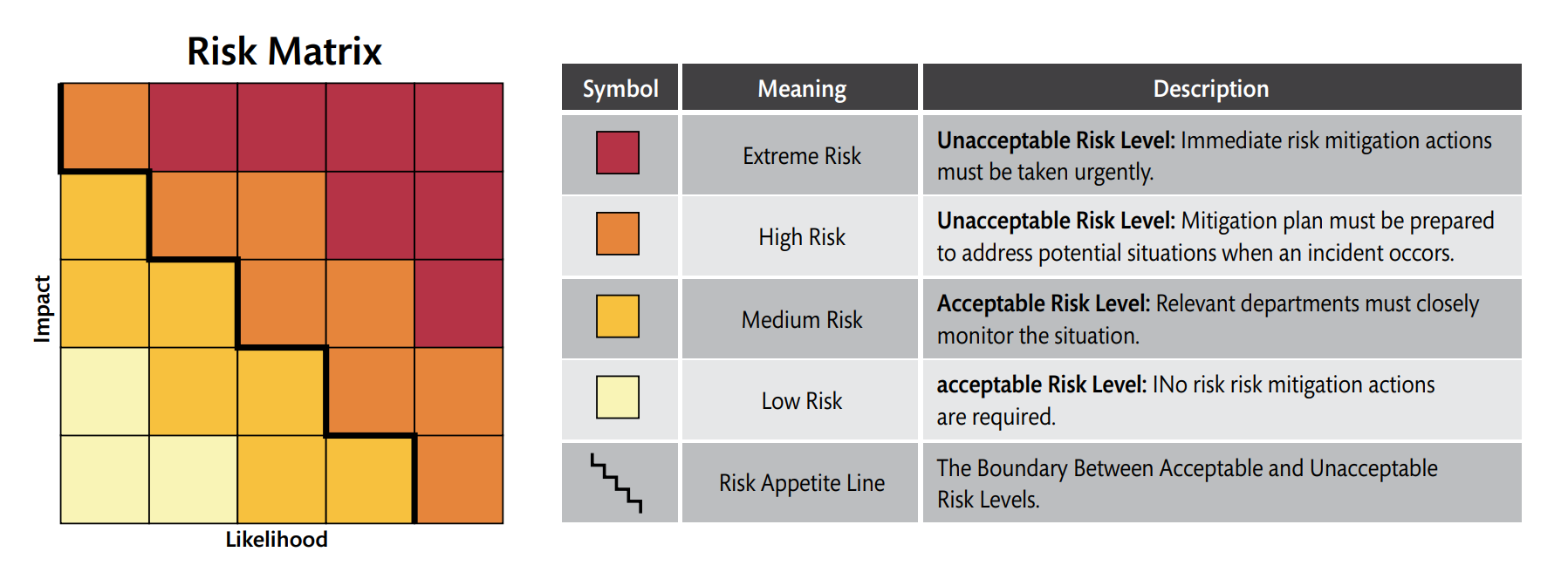
The Company determines Key Risk Indicators (KRIs) and calculates risk exposure by considering the likelihood of an event occurring and its potential impact. This is done to prioritize risks through a Risk Matrix, which serves as a tool for making informed decisions on appropriate risk response strategies. Additionally, the Company has established its risk appetite and risk tolerance levels, which are used as criteria for assessing and controlling risks in alignment with the organization's capacity to bear risk.
Identifying Risks
The Company conducts identification and assessment of risks, encompassing both external and internal factors that may impact business operations, categorizing these risks into 6 types:
Strategic Risks
Operational Risks
Financial Risks
Compliance Risks
Information Technology Risks
Social and Environment Risks
In addition, if an emerging risk occurs, the Company shall assess and analyze the risk in order that it is categorized into the relevant type according to the established corporate risk classification framework, while also considering the impact and significance of such risk in order to define appropriate management and monitoring guidelines.
Assessing the Risk Severity
The Company shall assess the severity of each risk by considering the likelihood of an event occurring and the level of impact on the organization, to appropriately and timely prioritize and determine risk management guidelines.
Risk Response
The Risk Owner, in collaboration with management, determines the risk response guidelines in alignment with the severity level and the deviation from the acceptable risk appetite. These guidelines consider four response strategies: Risk Mitigation, Risk Transfer, Risk Avoidance, and Risk Acceptance. Following the determination of these management guidelines, the Company shall maintain the risk level within the acceptable framework to ensure continuous business operations and the achievement of established objectives.
Monitoring and Reporting of Risk Management Results
The risk owner is responsible for monitoring and controlling risks to maintain them within acceptable levels and for preparing risk management performance reports for submission to the Risk Management Committee at least quarterly. Additionally, the Company emphasizes promoting risk learning and awareness at all organizational levels. In 2025, training was conducted on "Risk Awareness and Risk Culture Building" for the Board of Directors, the Executive Committee, the Risk Management Committee, the Audit Committee, the Internal Audit Department, the risk management working group, as well as executives and key personnel.
Roles and Responsibilities in Risk Management
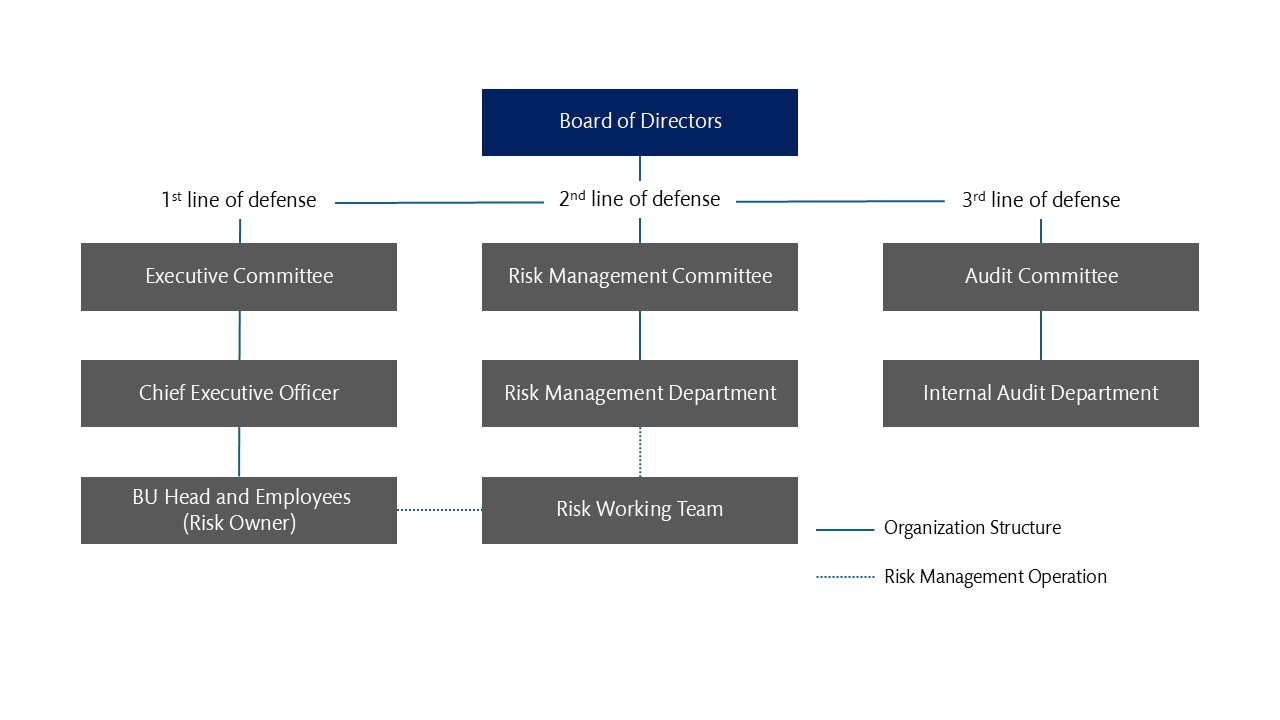
The Company has clearly defined roles, duties, and responsibilities for risk management and established a governance structure based on the Three Lines of Defense model. This structure serves as a framework for risk management, reporting, and review, with the following details:
Roles | Duties and Responsibilities |
Board of Director |
|
1st Line of Defense | |
Executieve Committee |
|
Chief Executive Officer |
|
Managements and Staffs - Risk Owner |
|
2nd Line of Defense: | |
Risk Management Committee |
|
Risk Management |
|
Risk Management Working Team consists of
|
|
3rd Line of Defense: | |
Audit Committee |
|
Internal Audit |
|
Business Continuity Management (BCM)
The Company operates its Business Continuity Management (BCM) under an international standard framework to ensure preparedness for incidents that could impact operations. These include natural disasters, human-caused threats, utility failures, technological hazards, or other unforeseen events beyond control that might lead to operational disruption and result in losses to assets, personnel, and the organization's reputation.
To prepare for potential crises, the Company has developed a Business Continuity Plan (BCP) and appointed a Crisis Management Committee, which consists of senior executives from each functional line. The Chief Operating Officer serves as the Chairman of this committee.
The main responsibilities of the Crisis Management Committee are as follows:
Decision-making and directing actions and operations during a crisis.
Coordinate and respond to incidents effectively.
Oversee the communication of essential information internally and externally to ensure accuracy, appropriateness, and timeliness.
The Company's operations under the BCM framework are focused on rapidly restoring business operations and minimizing the impact of a crisis event to ensure business continuity and sustainability
Risks to the Company's Business Operations
Introduction
The Company conducts annual preparation and review of its risk management plan and Key Risk Indicators (KRIs) to assess and monitor risks that may impact current and future business operations. The focus is on ensuring effective action plans that are in place to prevent and mitigate the effects of these risks.
The Company emphasizes the economic, environmental, social, and governance (ESG) dimensions in its risk management. To align business operations with sustainable development guidelines, enterprise-level risks that could impact business operations have been categorized into 6 types, which are:
Strategic Risks
Operational Risks
Financial Risks
Compliance Risks
Information Technology Risks
Social and Environment Risks
Such classification serves as a guideline for the systematic identification, analysis, and evaluation of risks, and for consideration in determining appropriate and sufficient risk management measures for the level of risk faced by the organization.
Risk Register
| Risk Name | Risk Characteristics | Consequences | Management Measures | Related Risk Factors |
|---|---|---|---|---|
| The challenge of securing suitable land for future expansion | The Company plans future projects that rely on sourcing suitable land in locations that meet project development needs in line with customer demand and market trends. However, it faces several challenges, such as continuously rising land prices, intense competition in the real estate market (especially in high-potential locations), and risks from changes in government policies, such as city planning adjustments, issuance of land use control laws, or tax measures. | Failure to acquire land according to specified criteria (size, location, price, legal title, and environmental suitability) or within the set timeframe will result in delays or the inability to develop new projects as targeted. This will lead to a decrease in future revenue and affect business growth. Furthermore, investment costs may rise due to competition for potential locations, and changes in regulations could add complexity to operations, ultimately causing the Company to lose competitive opportunities, shareholder confidence, and potentially affecting its corporate image. | The Company prioritizes proactive strategic planning for land acquisition, utilizing data and technology to analyze market trends and manage risks associated with land price volatility and competition in high-potential locations. The Company operates under principles of transparency and fairness towards all involved parties, from landowners to agents and brokers. Furthermore, it establishes a flexible budget framework to accommodate rising prices and builds strategic alliances with other project developers and financial institutions to enhance access to land opportunities. In addition, the Company has an online system for the offering of land for sale and lease, as well as official communication channels, to increase convenience, speed, and transparency of transactions. It has also created a land database to maintain competitiveness and support future project development. | 740 · Description: Shortage or fluctuation in pricing of raw materials or productive resources · Info category: OPERATIONAL_RISK · 746 · Description: Delays in the development of future projects · Info category: OPERATIONAL_RISK · 1714 · Description: Competition risk · Info category: STRATEGIC_RISK |
| Risk from construction material price fluctuations | In 2025, the prices of key construction materials such as steel, cement, green materials, and smart home technologies continue to face ongoing volatility due to several factors: the fragility of the global economy and energy prices, uncertainties arising from geopolitical conflicts affecting supply chains, as well as the rebalancing of supply and demand within industrial markets. In addition, the demand for eco-friendly materials and new technologies is placing upward pressure on material prices and sourcing, directly impacting cost management for the Company's horizontal and vertical real estate projects. | If this risk is not managed effectively, it may cause project costs to exceed estimates, impacting the Company's gross profit margin and return on investment. Additionally, competitiveness might decrease due to the necessity of adjusting product selling prices. If work quality or delivery schedules are affected, customer trust and satisfaction could be impacted. Furthermore, cost uncertainty adds complexity to planning and budget management, affecting the Company's strategic decision-making and resource allocation. | The Company has established a long-term material procurement agreement with a primary manufacturer to secure supply stability. Concurrently, material prices are consistently monitored to analyze pricing trends, enabling precise and timely purchasing decisions. An emergency contingency budget is allocated for all projects, and Value Engineering concepts are applied right from the design phase to reduce costs without compromising quality. Furthermore, risk is mitigated by building strategic alliances with multiple material manufacturers and actively exploring high-quality, eco-friendly substitute materials. These strategies allow for prompt operational plan adjustments and help maintain market competitiveness. | 737 · Other name: Geopolitical Tensions · Description: Other · Info category: STRATEGIC_RISK |
| Risks from macroeconomic factors pressuring purchasing power and market competition | In 2025, the Thai economy slowed down due to both internal and external pressures, such as political uncertainty, trade wars, and global economic volatility. At the same time, the high ratio of household debt to GDP led financial institutions to tighten lending, which significantly reduced consumer purchasing power. Additionally, consumer behavior shifted towards a preference for renting or buying second-hand homes over new ones, intensifying market competition. Compounded by an oversupply situation, developers had to accelerate inventory clear-outs through price wars and increased marketing costs to stimulate sales. This situation put pressure on the Company' s selling prices and profit margins, increasing the risk to its operating performance and competitiveness. | Presales and transfers declined due to contracting purchasing power and tighter credit conditions, leading to customer loan rejections. Simultaneously, intense competition from an oversupplied market and consumer behavior shifting towards renting or buying second-hand homes, further pressured the Company to increase marketing costs to accelerate inventory clearance. This resulted in squeezed profit margins and increased liquidity risks, causing the gross profit margin to decrease, which impacted the Company's overall competitiveness and performance. Furthermore, this risk affected to investors' confidence and credit rating in the future. | The Company consistently conducts economic and market data analyses to forecast purchasing power trends and consumer behavior, while developing products that meet specific niche demands, such as homes with smart functions or eco-friendly materials, to differentiate and add value. It adjusts sales and marketing strategies flexibly, utilizing targeted marketing via online channels. Financial strength is maintained through stringent liquidity management and cost control, along with close monitoring of market condition changes and competitors, while building strategic alliances with financial institutions to develop suitable loan products for customers. | 728 · Description: Volatility in the industry in which the company operates · Info category: STRATEGIC_RISK · 729 · Description: Behavior or needs of customers / consumers · Info category: STRATEGIC_RISK · 1725 · Description: Income volatility · Info category: FINANCIAL_RISK · 1714 · Description: Competition risk · Info category: STRATEGIC_RISK · 1715 · Description: Economic risk · Info category: STRATEGIC_RISK |
| Damage to reputation and corporate image affecting stakeholder confidence | The Company focuses on building a strong brand and earning customer trust. However, there is a risk that its reputation and image could be damaged by incidents that undermine confidence, such as substandard product and service quality, lack of transparent communication, improper crisis management, or violations of laws and ESG (Environmental, Social, and Governance) standards. Such risks may stem from lax internal quality controls, the rapid spread of negative information on social media, incomplete data disclosure, or disregarding community concerns. Furthermore, implementing projects that negatively impact local livelihoods and the environment—such as developments that increase congestion, strain local infrastructure, create pollution, or involve improper waste management—poses a significant threat. Without effective control measures, these issues could lead to environmental regulatory violations and further erode stakeholder trust. | Failure to adapt promptly to shifts in consumer behavior and technology results in products and services that do not meet diverse and modern demands, leading to a loss of market interest and reduced competitiveness. Furthermore, the inefficient use of technology and data can increase operating costs and create inefficient workflows, which ultimately impacts brand image, customer confidence, and long-term revenue opportunities. | The Company upholds the highest quality standards at every stage of project execution by developing rigorous quality management and internal audit systems. It has enhanced its after-sales service and complaint management to be both efficient and responsive, utilizing accurate, transparent, and creative communication strategies across all channels. Furthermore, the Company has established crisis management plans and conducts regular simulations to bolster readiness for unexpected events. It leverages social listening technology to monitor critical social issues and address concerns promptly. Additionally, it conducts Environmental Impact Assessments (EIA) and implements environmental measures—such as waste management, pollution reduction, and resource efficiency—alongside continuous community engagement. These efforts aim to build trust and mitigate reputational risks across all dimensions. | 1723 · Description: Legal risk · Info category: COMPLIANCE_RISK · 745 · Description: Loss or damage from non-compliance of partners or counterparties · Info category: OPERATIONAL_RISK · 736 · Description: Damage to company image and reputation · Info category: STRATEGIC_RISK · 749 · Description: Safety, occupational health, and working environment · Info category: OPERATIONAL_RISK · 750 · Description: Climate change and disasters · Info category: OPERATIONAL_RISK · 1717 · Description: ESG risk · Info category: STRATEGIC_RISK · 751 · Description: Impact on the environment · Info category: OPERATIONAL_RISK · 753 · Description: Impact on human rights · Info category: OPERATIONAL_RISK |
| Innovation development and technology deployment that are lagging behind customer needs | Consumer demands in the real estate market are changing rapidly, particularly expectations for projects that integrate innovation, technology, and new lifestyles, such as smart home systems, pet-friendly residences, and personalized goods and services. This risk also includes rapid and disruptive technological change. If organizations cannot apply technology and data internally, such as data analytics systems to understand customers or AI in work processes, delayed investment or adaptation will result in the inability to develop products and services that meet demands in a timely manner, leading to a loss of long-term competitiveness. | Failure to adapt promptly to shifts in consumer behavior and technology results in products and services that do not meet diverse and modern demands, leading to a loss of market interest and reduced competitiveness. Furthermore, the inefficient use of technology and data can increase operating costs and create inefficient workflows, which ultimately impacts brand image, customer confidence, and long-term revenue opportunities. | The Company continuously focuses on developing innovations that meet customer lifestyles by tracking real estate and technology trends and improving work processes to reduce the time required to bring new technologies to market. It builds collaborations with technology partners and startups to accelerate adoption and establishes internal technology teams to continuously experiment with and develop new innovations. Additionally, the Company uses customer feedback to develop product and service quality and communicates with customers transparently to maintain maximum confidence and satisfaction. | 729 · Description: Behavior or needs of customers / consumers · Info category: STRATEGIC_RISK · 732 · Description: Changes in technologies · Info category: STRATEGIC_RISK · 743 · Description: Product obsolescence · Info category: OPERATIONAL_RISK · 752 · Description: Impact from population structure · Info category: OPERATIONAL_RISK |
| Cybersecurity risks | Thailand faced increasingly severe and complex cyber threats in 2025, particularly sophisticated phishing and ransomware attacks, which directly impacted organizations' critical systems and sensitive data. In addition, emerging risks from the application of AI without proper governance are significant factors that could lead to the misuse of information, violations of the Personal Data Protection Act (PDPA), and intellectual property infringement. All of these factors affect business credibility and continuity. | A company's inability to effectively manage cyber threats can lead to the disruption of core operations, the leakage of critical data, and severe financial damage, including fines for PDPA violations. The risk associated with using AI without proper governance may increase legal and ethical risks, causing the company to lose credibility, stakeholder trust, and diminish its business competitiveness. | The Company has invested in state-of-the-art cybersecurity infrastructure and technology, such as threat detection and response systems. It has established stringent policies and operational measures, alongside continuous security awareness training for all employees. Regular risk and vulnerability assessments of the Company’s systems are conducted consistently. It has developed comprehensive incident response and system recovery plans. Furthermore, the Company audits and evaluates the security posture of its business partners and complies with international regulations and standards to build stakeholder trust and protect their data. | 758 · Description: Violations of laws and regulations · Info category: COMPLIANCE_RISK · 732 · Description: Changes in technologies · Info category: STRATEGIC_RISK · 1723 · Description: Legal risk · Info category: COMPLIANCE_RISK · 744 · Description: Information security and cyber-attack · Info category: OPERATIONAL_RISK · 736 · Description: Damage to company image and reputation · Info category: STRATEGIC_RISK · 1720 · Description: System disruption risk · Info category: OPERATIONAL_RISK |
| Legal and regulatory compliance risk | The risk arising from changes in laws, regulations, and associated requirements pertaining to real estate project developments, tend to be complex and continuously evolving according to economic, social, and environmental contexts. Relevant laws cover a spectrum from urban planning laws, environmental laws, construction permit regulations, tax requirements, building control, to energy and sustainability standards. These changes may increase approval processes and compliance requirements, resulting in operational delays and increased project development costs, especially in cases where new laws related to ESG or stricter carbon emission standards are introduced. | Failure to adapt swiftly to changes in laws and regulations can have a significant impact on operations and financial performance. This can range from delays in permit applications or projects being halted for remediation, which leads to higher costs, lost business opportunities, and exposure to penalties such as fines or cease-and-operate orders. Additionally, modifying designs and materials to comply with new regulations may affect profit margins and competitiveness. Furthermore, inadequate response time can damage an organization's reputation and credibility, along with the risk of legal action. | The Company has established procedures to closely monitor, analyze, and forecast trends in legal and regulatory changes, proactively assessing their strategic impacts and building readiness for adaptation, and strengthening collaboration with government agencies and associations to participate in providing policy feedback. | 756 · Description: Change in laws and regulations · Info category: COMPLIANCE_RISK · 757 · Description: Laws and regulations is not favorable for doing business · Info category: COMPLIANCE_RISK · 758 · Description: Violations of laws and regulations · Info category: COMPLIANCE_RISK · 759 · Description: Corporate Governance · Info category: COMPLIANCE_RISK · 1723 · Description: Legal risk · Info category: COMPLIANCE_RISK |
| Risks of severe natural disasters | The Company considers the impact of climate change a significant emerging risk, particularly extreme weather events such as sudden heavy rainfall or "rain bombs", which can lead to flooding even in areas previously unaffected. This risk is characterized by uncertain frequency but high impact, and may intensify in line with climate change trends. | Climate change and natural disasters impact the Company’s operations in multiple dimensions. This ranges from the pre-construction phase, where the budget for earthwork needs to be increased to accommodate higher flood levels, to the construction phase, where extreme hot weather or heavy rain may necessitate adjusting work schedules or temporary shutdowns, leading to project delivery delays. Furthermore, damage from severe disasters directly affects repair costs, cash flow, and the Company’s interest burden. It also heightens safety risks which may cause damage to customer property, significantly harming the organization's reputation and credibility. | The Company assesses the project area using geospatial data to predict flood and disaster risks, and designs the project to be resilient according to construction standards, incorporating appropriate innovations such as drainage systems and weather-resistant building materials. Additionally, the Company has established contingency plans for adjusting work schedules during heavy rainfall or extreme heat, and implemented safety measures for workers, such as increasing the frequency of breaks in hot weather, to prevent health hazards. Regarding risk transfer, the Company secured insurance for the project and assets to mitigate financial impacts. Furthermore, it developed a Business Continuity Plan (BCP) and emergency response plans, conducting regular disaster response drills with partners and relevant agencies to ensure continuous operations even during unexpected events. | 750 · Description: Climate change and disasters · Info category: OPERATIONAL_RISK |
| Risks of the transition to a low-carbon economy | The Company recognizes the transition risks arising from the shift towards a green economy and the enforcement of new regulations such as the Climate Change Act and the Thailand Taxonomy Phase 2. These factors may exert pressure on business operations in new dimensions. This risk encompasses fluctuations in the costs of technology and innovations for green buildings, challenges in sourcing low-carbon construction materials, and limitations regarding specialized personnel. If the organization fails to adapt in a timely manner to changing regulations and market mechanisms, it could impact its ESG targets and long-term profitability. | Failure to meet sustainability goals may result in companies facing higher costs from environmental regulatory compliance. In the future, access to green finance and tax incentives may become more difficult, reducing attractiveness to investors who value ESG (Environmental, Social, and Governance) factors. This could also lead to damage to the organization's reputation and image, potentially making the brand appear socially and environmentally irresponsible. Such damage impacts the confidence of customers, partners, and investors, ultimately leading to a loss of business opportunities and long-term competitiveness, especially as consumers shift toward competitors' projects that prioritize sustainability. | The Company is driving its goals to reduce greenhouse gas emissions under the "SCero Mission", a cornerstone of its pursuit of sustainable business practices. The mission aims to achieve a reduction of 100,000 tons of carbon equivalent by the year 2030, encompassing internal operations and extending cooperation across the supply chain. This is accomplished through the design of projects and the selection of materials that emphasize energy and resource efficiency, utilizing green innovations and technologies under the Company's green procurement policy to create a positive impact throughout the lifecycle. Carbon emissions are monitored annually, and the data has been verified and certified according to the ISO 14064-1 standard for the third consecutive year. In addition, the Company is developing the Company's green building and wellness standards across all products within the appropriate context. This involves studying international green building standards such as LEED (Leadership in Energy and Environmental Design), TREES (Thai Rating of Energy and Environmental Sustainability), EDGE (Excellence in Design for Greater Efficiencies), and WELL (WELL Building Standard) to define criteria suitable for the business. Appropriate and customer-demanded international standards have also been applied for certification in some of the company's products and projects. The plan is expected to be completed by early 2026. Having green building and wellness standards allows the Company to improve internal processes and build alliances with green material manufacturers and financial institutions to access Green Finance, coupled with developing personnel potential to enhance the organization's competitiveness for sustainable growth. | 1717 · Description: ESG risk · Info category: STRATEGIC_RISK · 1719 · Description: Climate change and disasters · Info category: STRATEGIC_RISK |
| Human rights risks across the supply chain | The Company recognizes the evolving context of human rights risks, shifting from internal governance to supply chain due diligence (SCDD). This is particularly pertinent in the construction industry, which is vulnerable regarding the issue of migrant labor. A key risk lies in the potential for partners or subcontractors to engage in practices that do not align with labor and human rights standards. | Human rights violations within the supply chain not only impact intangible assets like brand image and consumer trust, affecting purchasing decisions, but also directly affect costs and financial stability. In the event of severe violations, companies may face trade sanctions, investment freezes, or widespread reputational damage. Furthermore, a reduction in the Company's ESG rating could lead to a loss of access to green financing or higher financial costs, as well as the risk of a reduction in holdings from institutional investors. If a trading partner is suspended due to labor issues, the supply chain is disrupted, causing project delays and increased costs from finding replacement contractors, ultimately impacting net profit. | The Company conducts comprehensive Human Rights Due Diligence (HRDD) across all stages of the supply chain, ensuring alignment with our Human Rights Policy and Code of Conduct for partners. It screens and evaluates potential partners and contractors during the selection and bidding processes. These requirements are enforced through procurement contracts once work is awarded. Regular on-site audits of partners and contractors are conducted, and channels for complaints and remedy processes are established for any violations found. Furthermore, it has collaborated with the Building Social Impact (BSI) project by the Foundation for Child Development Network (FCD) to enhance safety standards within labour camps and for their families. | 733 · Description: Business operations of partners in the supply chain · Info category: STRATEGIC_RISK · 745 · Description: Loss or damage from non-compliance of partners or counterparties · Info category: OPERATIONAL_RISK · 753 · Description: Impact on human rights · Info category: OPERATIONAL_RISK |
Risks to Securities Holders' Investment
Risk Register
| Risk Name | Risk Characteristics | Consequences | Management Measures | Related Risk Factors |
|---|---|---|---|---|
| Risk related to having major shareholders with over 50% ownership | The Shinawatra family group holds more than 50% of the total issued and outstanding shares of the Company (as of December 31, 2025) | The major shareholder group can exercise their rights to object to or disapprove resolutions at the shareholders' meeting regarding matters where the Company's articles of association or relevant laws require a vote of not less than three-fourths (3/4) of the total votes of the shareholders attending and entitled to vote. | The Board of Directors and the Executive Committee are fully authorized and responsible for setting the direction and policies for business management. Additionally, the Company has an Audit Committee to review and consider transactions to prevent potential conflicts of interest. Furthermore, the Securities and Exchange Commission (SEC) has the duty to supervise listed companies on the Stock Exchange of Thailand to ensure that operations are correct, transparent, and comply with all SEC laws, regulations, and criteria to protect the interests of investors. | 768 · Description: Return from investment of securities holder · Info category: HOLDER_RISK · 2969 · Description: Risk of the company having a majority shareholder holding > 50% of shares · Info category: HOLDER_RISK |